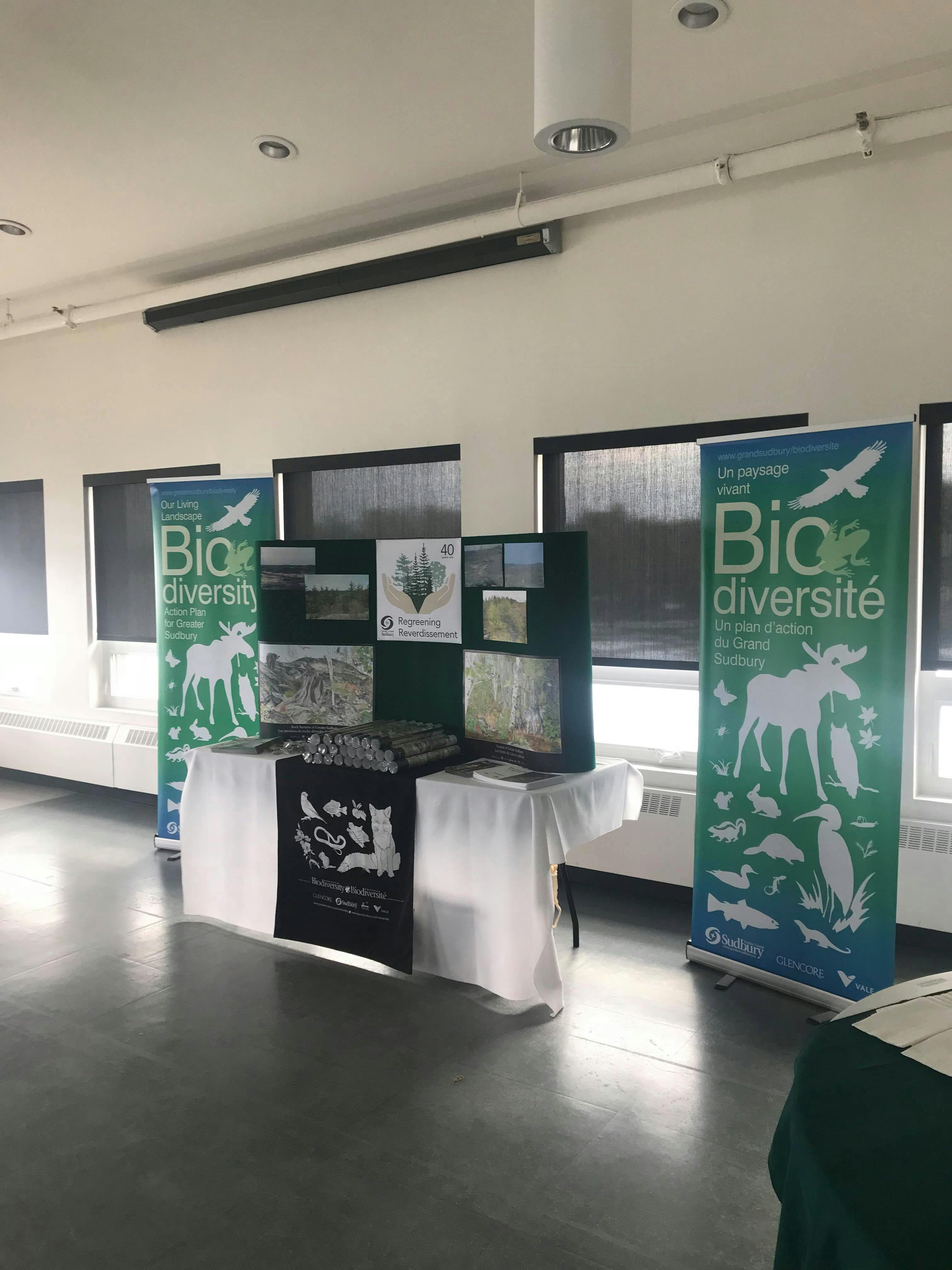
45th Anniversary of Regreening

This internationally recognized program, which began in 1978, has put Greater Sudbury on the map as an environmental leader. Over the past 40 years Greater Sudbury has made a miraculous transformation from a moonscape to a living landscape.

This internationally recognized program, which began in 1978, has put Greater Sudbury on the map as an environmental leader. Over the past 40 years Greater Sudbury has made a miraculous transformation from a moonscape to a living landscape.

Tell your story

Do you have a story to tell, or photographs to share of how Sudbury’s blackened past has transformed into a greener, healthier environment? We want to hear from you! Post your story, share your photos, and help spread the word of how 40 years of Regreening in Greater Sudbury has transformation our local environment.


Thank you for sharing your story and photos with us!

You need to be signed in to share your story.

All fields marked with an asterisk (*) are required.

  • Skead Road 1982

    by treelady94, almost 8 years ago
    Anne S. B. writes:I worked two summers for the Land Reclamation Program in 1981 & 1982. These photos were taken in Skead on the east side of the road in 1982.

    Anne S. B. writes:I worked two summers for the Land Reclamation Program in 1981 & 1982. These photos were taken in Skead on the east side of the road in 1982.

  • Ministry Of Environment Staff Volunteer Planting Efforts By John Negusanti (Retired MNR/MOE Forester/Phytotoxicologist

    by John Negusanti, almost 8 years ago

    As part of Sudbury's Land Reclamation program MOE staff planted trees on at least 8 separate years in sites selected by Tina McCaffrey and myself. Planting took place each spring when conditions were optimal. We usually planted between 4 and 5 thousand trees(mostly potted stock) in highly visible hillsides along Sudbury roads.These projects amounted to the planting of over 40 thousand trees which is a substantial contribution to Sudbury's landscape. MOE management allowed the planting to be done on Ministry time as an environmental initiative. As the main organizer of these events I feel the MOE staff derived great pleasure... Continue reading

    As part of Sudbury's Land Reclamation program MOE staff planted trees on at least 8 separate years in sites selected by Tina McCaffrey and myself. Planting took place each spring when conditions were optimal. We usually planted between 4 and 5 thousand trees(mostly potted stock) in highly visible hillsides along Sudbury roads.These projects amounted to the planting of over 40 thousand trees which is a substantial contribution to Sudbury's landscape. MOE management allowed the planting to be done on Ministry time as an environmental initiative. As the main organizer of these events I feel the MOE staff derived great pleasure and satisfaction from these activities. 

  • The Alexander Center Forest By John Negusanti (Retired MNR/MOE Forester/Phytotoxicologist)

    by John Negusanti, almost 8 years ago

    The major credit has to go to a Sudbury legend- Cliff Fielding whose persistence paid off to plant a forest on his property at Alexander Center.

    In 1975 he had 5000 SW planted and they all died.He called me the spring of 1976 and inquired about getting trees planted for free for research purposes.Part of my MNR job at the time as a contract forester was to do research into establishing trees in the Sudbury barrens. I told Mr Fielding that I couldn’t Deem planting his property as research but that I would visit... Continue reading

    The major credit has to go to a Sudbury legend- Cliff Fielding whose persistence paid off to plant a forest on his property at Alexander Center.

    In 1975 he had 5000 SW planted and they all died.He called me the spring of 1976 and inquired about getting trees planted for free for research purposes.Part of my MNR job at the time as a contract forester was to do research into establishing trees in the Sudbury barrens. I told Mr Fielding that I couldn’t Deem planting his property as research but that I would visit his property and give him advise on planting.

    So I met with MR Fielding and I suggested that he get his property grassed and then plant a mix of Pr and Pj bareroot stock.I knew through my work with Keith Winterhalder of Laurentian University that the grass was needed to provide the micro-site to enable the trees to establish in such a harsh environment. 

    Through his connections with INCO Mr Fielding  got Mike Peters of the INCO ag dept. to establish grass on his property that summer/fall.

    I ordered 2500 Pj and 2500 PR bareroot stock grown at the MNR Midhurst nursery grown from seed collected in the Sudbury seed zone.  I delivered the trees to the site in early May 1977 on a Friday (bags of 500 trees) and put them down by the Creek and tarped them to protect them from the sun. I showed up early on the Saturday morning and there was a member of Mr Fielding staff placing the bareroot stock out on the field every 10 feet before planting to get perfect rows at the spacing that I recommended. I had a canary (Italian moment) and blasted the poor employee that was just doing what HE WAS TOLD. We quickly gathered up the trees and put the roots in the creek water.I supervised the rest of the plant that weekend.

    The survival was a lot higher than I anticipated but I think Mr Fielding had his staff water the trees until they were established.

    I noticed that MR Fielding had more trees planted over the next several years. The end.

  • Early MNR Involvement

    by treelady94, almost 8 years ago

    Jim McCready R.P.F (retired Ministry of Natural Resources & Forestry) writes:

    It was when I was a forestry student in the late 60’s that a number of us would be travelling through Sudbury to our summer jobs in the Kenora area. It was so barren we all said we would never work in Sudbury when we graduated.

    Guess what; I graduated in 1971 and where did they send me but to Skead. It was at that time I inherited the Greening of Sudbury project from Ed Kraker the forester of the day. The project was a joint effort... Continue reading

    Jim McCready R.P.F (retired Ministry of Natural Resources & Forestry) writes:

    It was when I was a forestry student in the late 60’s that a number of us would be travelling through Sudbury to our summer jobs in the Kenora area. It was so barren we all said we would never work in Sudbury when we graduated.

    Guess what; I graduated in 1971 and where did they send me but to Skead. It was at that time I inherited the Greening of Sudbury project from Ed Kraker the forester of the day. The project was a joint effort of the Ministry of Natural Resources (Lands & Forests in those days) with Professor Keith Winterhalder and Dr. Gerard Courtin of Laurentian University. A number of plots where being studied on flat very dry sites between Skead and the airport. We were studying a number of species as to what could best grow in the Sudbury sites. We knew we had to put down lime and it was up to Keith and Dr. Courtin to come up with how much. Later we new we had to put down grass as the surface temperatures of the soil were frying the trees we were trying to plant. The results; Jack pine was the best choice of tree and 2 tons of lime/acre.

      Keith had set up a number of grassing trials north of Coniston, which were limed to see what grass seed would do the best. The Ministry was experimenting with containers and I knew Jack Pine containers would go well at this site. We planted these trial sites with these new containers. Keith at the time was not pleased, as we had miss communications planting on his grass trials. The rest is history, as those earlier trials in Coniston showed we had the right lime mixture, success with the grass and have an established Jack pine plantation.

      In 1976 funding was still coming from the Ministry of Natural Resources and I hired John Negusanti to work on the program. When the Land Reclamation Program became operational in 1978, I attended one meeting of VETAC and then was transferred to Eastern Ontario.

      I worked for Tree Canada from 2007 – 2016 and partnered with Tina McCaffrey on a number of projects during that time planting trees in the Sudbury area. I could not get over the species she was planting and the success she was having especially with white pine, I would have never thought back in the Skead days. Sites were too hot.

     Great job all around to everyone involved in this project over the past 40 plus years.

  • Moved Back just for this

    by Greener, almost 8 years ago

    After leaving Sudbury most other highly educated individuals in the tech industry, Sudbury pulled us back in. Although there is no employment here, the tradeoff to be able to enjoy the outdoors the way we can has been worth it. I remember growing up in New Sudbury where my backyard connected a swampy field and junction creek. By the time I moved away, it was almost a forest and just recently I drove by, the trees have matured to well over 20-30 feet. This story is repeated throughout the city.

    Unfortunately, all these efforts are going to be reversed when... Continue reading

    After leaving Sudbury most other highly educated individuals in the tech industry, Sudbury pulled us back in. Although there is no employment here, the tradeoff to be able to enjoy the outdoors the way we can has been worth it. I remember growing up in New Sudbury where my backyard connected a swampy field and junction creek. By the time I moved away, it was almost a forest and just recently I drove by, the trees have matured to well over 20-30 feet. This story is repeated throughout the city.

    Unfortunately, all these efforts are going to be reversed when Mayor Bigger joined a 'race to the bottom' in order to attract a terrible emission producer and pollutant by deciding to potentially place a ferrochrome smelter in a protected provincial park. Daisy Lake Uplands is set aside for study of the site's ability to recover on its own without human intervention (https://www.ontarioparks.com/park/daisylakeuplands). Among many other risks associated with this plant, if it is announced that it will be coming to Sudbury, my young family and I will be moving away to greener, safer pastures. 

    As we celebrate 40 years of regreening, let's continue looking forward to the future and protecting these efforts!

  • Part of the transformation and proud of it!

    by treelady94, almost 8 years ago

    As a child I lived in Sudbury and I remember sliding down hills in the winter and not hitting a single tree, and making forts on rock edges and using old tree roots for “phaser” guns. 

    Now I am all grown up and I am the foreperson for the City of Greater Sudbury's Land Reclamation Program. This will be my 19th year and in this time I have helped contribute to the planting of 4,822,903 trees and shrubs, limed 195 hectares of barren rock and laid 1.84 hectares of forest floor transplants. I also have had the privilege of... Continue reading

    As a child I lived in Sudbury and I remember sliding down hills in the winter and not hitting a single tree, and making forts on rock edges and using old tree roots for “phaser” guns. 

    Now I am all grown up and I am the foreperson for the City of Greater Sudbury's Land Reclamation Program. This will be my 19th year and in this time I have helped contribute to the planting of 4,822,903 trees and shrubs, limed 195 hectares of barren rock and laid 1.84 hectares of forest floor transplants. I also have had the privilege of supervising over 800 workers all who have all taught me something along the way. I can tell you that this job isn’t easy, dealing with all the outdoor elements (bugs, rain, cold, wild life and of course the physical part of the job). It is not uncommon to walk 5 to 10 kms a day over rough terrain, it is also not uncommon to laugh at least 5 times day and smile more times than I can count. I have formed lasting friendships with my co workers and my superiors past and present. But the greatest accomplishment of course is the end result. One of my first liming sites was the typical black rock with patches of dry dirt and the odd stunted birch tree here and there. The long hot summer of liming and fertilizing came and went and we returned to plant trees in the spring.  Imagine our amazement when we topped the hill to see an endless landscape of green grass and a deer off in the distance.  I could tell you many stories about the life and times on “Land Rec”, but I sure would love to hear yours!

Page last updated: 01 Nov 2023, 04:18 AM