Development Liaison Advisory Committee (DLAC)

Welcome to the dedicated Greater Sudbury Development Liaison Advisory Committee (DLAC) page.

Here you can find the latest news regarding development and growth in Greater Sudbury, ask the City of Greater Sudbury team questions and find past meeting minutes and DLAC history.

DLAC is designed to bring together key development/construction industry interests (developers, construction associations, development consultants and approval authorities) for the purpose of maintaining and improving the development/construction environment within the City of Greater Sudbury.

Welcome to the dedicated Greater Sudbury Development Liaison Advisory Committee (DLAC) page.

Here you can find the latest news regarding development and growth in Greater Sudbury, ask the City of Greater Sudbury team questions and find past meeting minutes and DLAC history.

DLAC is designed to bring together key development/construction industry interests (developers, construction associations, development consultants and approval authorities) for the purpose of maintaining and improving the development/construction environment within the City of Greater Sudbury.

  • City of Greater Sudbury Prepares for 2026 Municipal and School Board Elections

    The City of Greater Sudbury has begun preparations for the Municipal and School Board Elections taking place on Monday, October 26, 2026. An update provided at the February 24 City Council meeting outlines key dates and proposed by-laws for matters including internet voting, the use of optical scan tabulators, and restrictions on candidates’ use of municipal resources during the campaign period.

    This fall, residents will be encouraged to voice their choice through a hybrid voting model designed for accessibility and convenience. Online voting will be available from Friday, October 16 to Monday, October 26, allowing electors to vote from their own devices at any time and anywhere. Those preferring to vote in person may do so on Election Day or during advance voting on Saturday, October 17 and Saturday, October 24.

    Residents are encouraged to ensure their information is up to date in advance of the upcoming elections. As of January 2024, the list of eligible electors for municipal elections is maintained by Elections Ontario, while Municipal Property Assessment Corporation (MPAC) continues to manage school support information. Voter registration can be confirmed at RegisterToVoteON.ca, and school support details can be reviewed at school-support.mpac.ca.

    Nominations for Mayor, Councillors, and School Board Trustees open on Friday, May 1, 2026. Prospective candidates are encouraged to monitor the City’s website for forms and updates as they become available from the Ministry of Municipal Affairs and Housing.

    The Municipal Elections team will increase public outreach throughout the spring, including voter education tools, registration reminders, and appearances by the Municipal Elections-branded GOVA bus. Information will continue to be updated at: www.greatersudbury.ca/city-hall/municipal-schoolboard-elections/.

  • Greater Sudbury Providing an Answer to Canada’s Critical Minerals Future

    Global demand for critical minerals is accelerating at a pace few sectors have experienced. The International Energy Agency projects that demand from clean energy technologies could quadruple by 2040. Other international analyses suggest even sharper increases for specific materials such as lithium, where demand could rise 40-times in the coming decades. At the same time, defence systems rely on rare earth elements for radar, satellites, guidance systems and advanced aircraft.

    What was once treated by governments as primarily a trade matter now sits at the centre of national security, economic sovereignty, electrification and supply-chain resilience.

    Greater Sudbury offers a real-world example of what is needed – and how it can be delivered.

    “Mining here isn’t a theoretical possibility,” says Paul Lefebvre, Mayor of Greater Sudbury. “We currently have nine active mines and will have 15 by 2030, five processing facilities, over 350 advanced supply and service companies, research institutes and training facilities, and a workforce that’s been doing this for generations. That existing ecosystem makes it easier – and up to decades faster – to move projects from planning into production. This area is clearly a special economic zone.”

    Read the full Globe and Mail article HERE.

  • Ontario unseated Saskatchewan as Canada's Top-Rated Jurisdiction for Mining Investment, Ranking 2nd Globally

    The Fraser Institute has released the Annual Survey of Mining Companies, and Ontario has ranked 2nd globally as a top-rated jurisdiction for mining investment.

    "The Fraser Institute's mining survey is the most comprehensive report on not only mineral potential but also government policies that either encourage or discourage mining investment," said Elmira Aliakbari, director of the Fraser Institute's Centre for Natural Resource Studies and co-author of the study.

    This year's report ranks 68 jurisdictions around the world based on their geologic attractiveness (minerals and metals) and government policies that encourage or discourage exploration and investment, including permit times.

    On overall investment attractiveness, Saskatchewan (3rd) ranks in the global top ten for the sixth time in seven years, with Ontario leading in 2nd place globally. In terms of policy factors alone, Alberta ranks in the global top three while Ontario ranks 5th, Newfoundland & Labrador ranks 7th, and Saskatchewan ranks 8th globally.

    READ THE FULL STUDY HERE

  • Greater Sudbury's Economy Shows Steady Growth in 2025 Economic Bulletin

    supporting image

    The City of Greater Sudbury closed 2025 with steady economic momentum, supported by major industrial investment, continued health care recruitment efforts, strong construction activity and a successful year for film and tourism.

    Construction activity remained strong throughout the year, with $597 million in total construction permit value issued across the residential, commercial, industrial and institutional sectors. Development activity included permits for 625 new housing units, as well as 71 permits issued for large projects each valued at more than $1 million.

    The City’s Economic Bulletin is released twice each year, with a six-month update covering January to June and a year-end report providing a full overview of economic activity from January to December. The 2025 year-end Economic Bulletin is available at investsudbury.ca.

  • Labour Force Survey Results - January 2026

    The Greater Sudbury labour force survey results for January 2026 are in.

    Labour Force refers to the total adult population available to the labour market at a specific time. As of January 2026, the labour force of Greater Sudbury (Census Metropolitan Area) is 104,400, a increase of 1400 from December 2025.
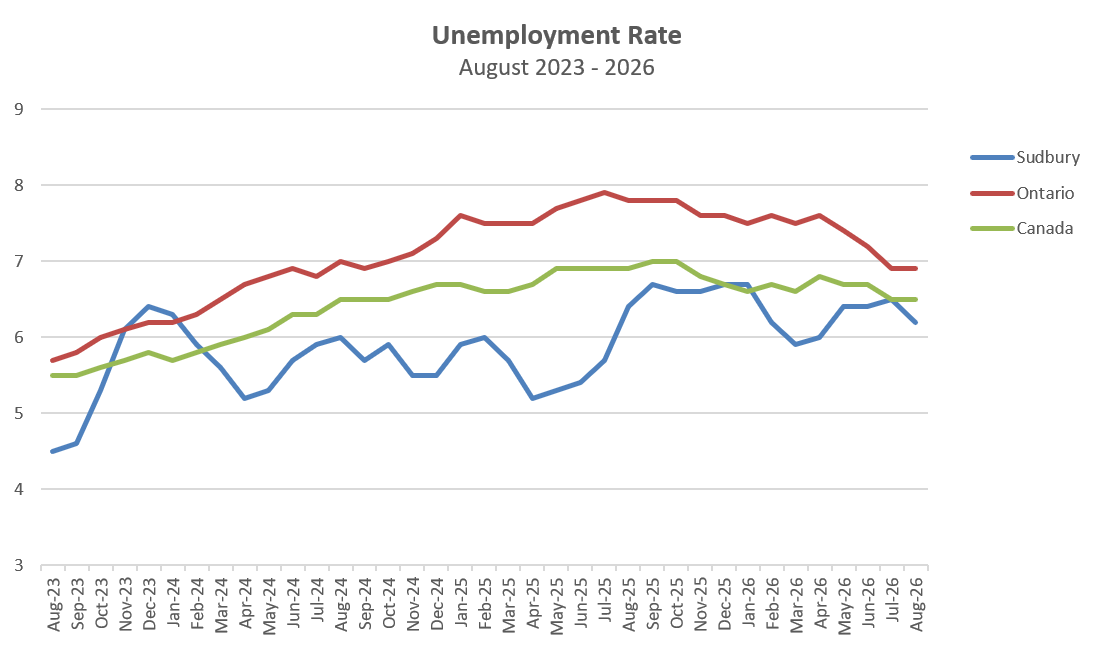
    The unemployment rate for Greater Sudbury (Census Metropolitan Area) in January is 6.7%. The unemployment rate in Ontario is 7.5% and Canada is 6.6%.
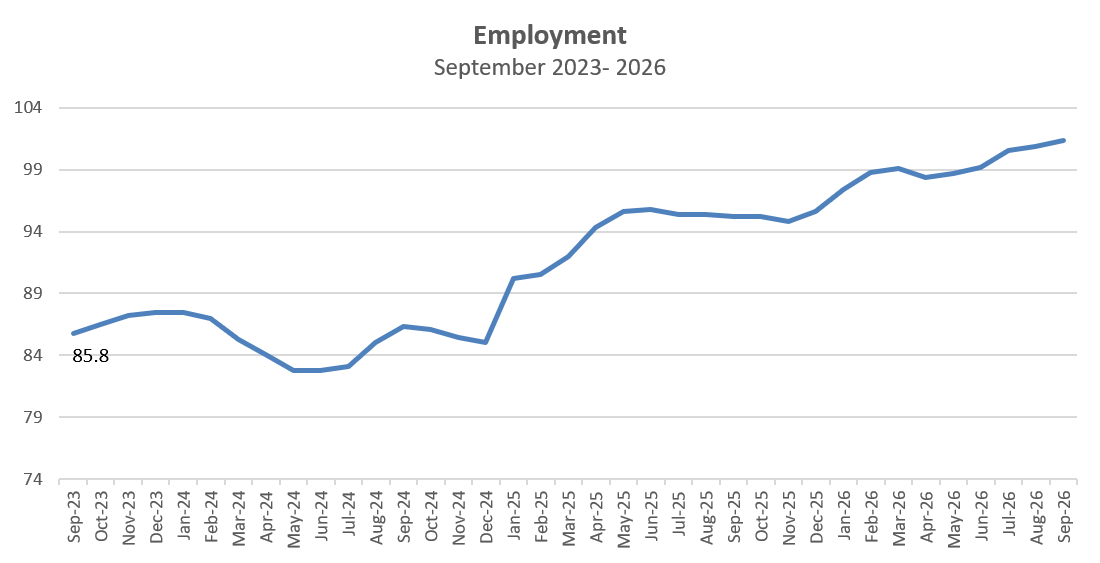
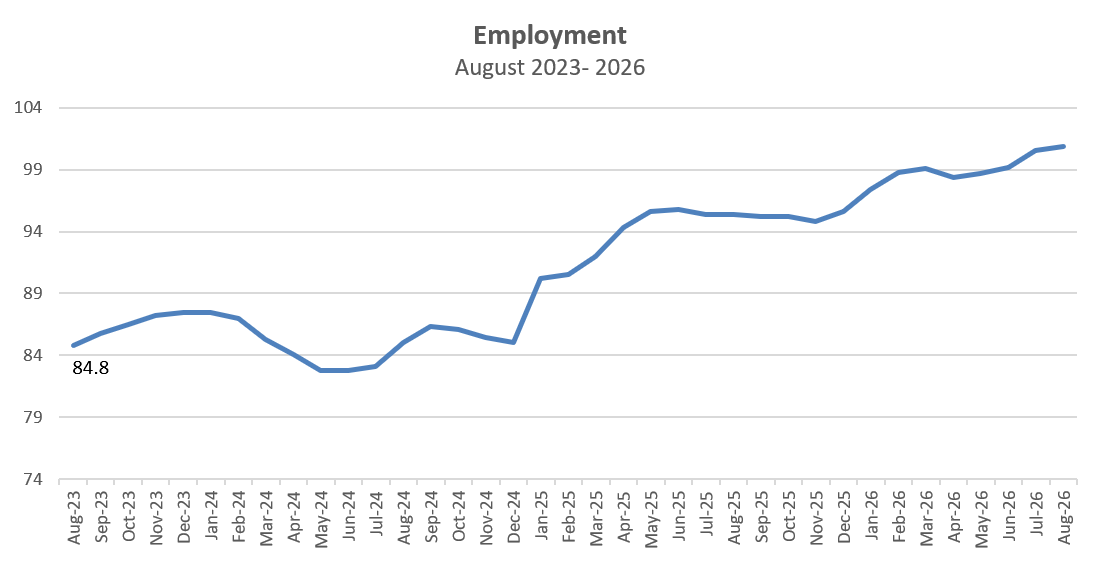
    The number of people employed in the city is 97,400, up from 96,100 in December 2025.
    The participation rate is 63.9%, a slight increase from December 2025. The participation rate remains below the pre-COVID peak of 65.1% in May 2019.


  • 2026 Priority Sectors and Occupations for Immigration Pilot Programs

    The City of Greater Sudbury is announcing the priority sectors and occupations for the 2026 Rural Community Immigration Pilot (RCIP) and Francophone Community Immigration Pilot (FCIP) programs, building on the first year of program delivery to ensure they continue to respond to local labour market needs and support economic growth.

    In 2025, the RCIP and FCIP programs supported 571 principal applicants, representing a total of 1,082 individuals, including accompanying family members. Demand for both programs continues to exceed available allocations, reflecting ongoing employer needs across key sectors. The City continues to welcome new applicants and encourages eligible employers to apply.

    For the 2026 RCIP program, six priority sectors have been selected: Business, Finance and Administration; Natural and Applied Sciences; Health; Education, Social, Community and Government Services; Trades and Transport; and Natural Resources and Agriculture. Priority occupations focus on high-skilled and in-demand roles, including healthcare professionals such as general practitioners, registered nurses and licensed practical nurses, engineering technologists, skilled trades and mining engineers.

    The 2026 FCIP priority sectors include Business, Finance and Administration; Health; Education, Social, Community and Government Services; Arts and Culture; Trades and Transport; and Natural Resources and Agriculture. Priority occupations emphasize bilingual and French-speaking talent in administration, health aide and support roles, social and community services, early childhood education, and skilled trades and agriculture.

    In 2026, Greater Sudbury has been granted 525 RCIP allocations and 45 FCIP allocations, which will be distributed across eight intake periods.

    The selection of the 2026 priority sectors and occupations was guided by Immigration, Refugees and Citizenship Canada (IRCC) parameters for the pilot programs and was informed by employer consultations, labour market analysis, targeted employer surveys and first-year program data. The Community Selection Committees, supported by the Greater Sudbury Development Corporation (GSDC), assisted in identifying priority sectors and occupations and approving designated employers.

    This work builds on the significant contributions of the GSDC during the previous Rural and Northern Immigration Pilot, which helped lay the foundation for the current RCIP and FCIP programs. Together with FedNor and IRCC’s ongoing investment since the inception of these pilots and the City of Greater Sudbury’s continued support, these partners have been essential in advancing the region’s newcomer attraction and workforce development goals.

    More information about the RCIP and FCIP programs is available at investsudbury.ca

  • City Council Backs New Supportive Housing Development

    On January 20, 2026, the City’s Finance and Administration Committee directed staff to apply for funding through the Build Canada Homes (BCH) supportive housing program stream which supports the development of new supportive and transitional housing projects. As part of this decision, Council also committed to funding operating costs required to meet BCH eligibility requirements.

    The resolution formed part of a broader report to Council on the Social Housing Revitalization Funding plan, which outlines the City’s plan to leverage BCH funding to develop a 40-unit supportive housing project in line with the City’s Roadmap to End Homelessness.

    “Expanding supportive housing is a core part of the City's strategy and is essential to building a healthier, more inclusive community,” said Greater Sudbury Mayor Paul Lefebvre. “This project represents another meaningful step that Council is taking to ensure residents in need can access the safe and supportive housing necessary to move forward. I look forward to partnering with our federal and provincial partners to get shovels in the ground.”

    As outlined in the report, the Greater Sudbury Housing Corporation (GSHC) is recommending a site adjacent to its building at 720 Bruce Ave. given the site’s proximity to existing housing and support services, as well as its readiness for construction.

    This plan also advances the objectives laid out in the 2019 Council-approved Social Housing Revitalization plan which sought to better align housing stock with community need. That plan has led to the divestment of over 50 homes to date, with proceeds reinvested into priority housing projects. These funds have supported the municipal share of the 1310 Sparks Street project ($4.6 million) and 1179 Lorraine Street project ($5.0 million).

    While the City will continue to pursue operational funding from the province, Council’s commitment to fund anticipated operating costs between $1.25 million and $2 million in the short term enables City staff to prepare the BCH application and begin engaging with supportive housing providers to identify a partner for the new development.

    To view the full Social Housing Revitalization plan report, visit Housing Revitalization Funding Plan

  • Post-Secondary Leaders Unite to Launch Sudbury Partnership for Higher Education

    On January 14, 2026, leaders from Cambrian College, Collège Boréal, Laurentian University and NOSM University took part in a Greater Sudbury Chamber of Commerce panel discussion about how Sudbury’s post-secondary institutions are adapting to meet the evolving needs of northern Ontario’s workforce and economy.

    Following this panel, the four leaders signed a Memorandum of Understanding (MOU), creating the Sudbury Partnership for Higher Education. The partnership marks a significant milestone in regional collaboration and long-term economic development.

    To learn more, visit: https://collegeboreal.ca/en/actualite/post-secondary-leaders-share-insights-create-new-partnership-at-chamber-luncheon/

  • Housing Accelerator Fund - 2024 Numbers

    The Housing Accelerator Fund (HAF) incentivizes and rewards local governments in their approaches to increasing housing supply and accelerating development timelines. The HAF was also meant to be a transparent program, with regular reporting mechanisms.

    On January 12, the Government of Canada announced the launch of the HAF Progress Tracker, the latest tool for public tracking of HAF progress in communities throughout Canada. Currently the data available is for 2023 and 2024.

    With that said, in 2024, Greater Sudbury received the most funding of all Ontario cities taking part in the program.

    Funding Received: $16,072,484

    HAF Incentivized Units: 485

    Housing Supply Growth Target: 2,628

    To be approved for HAF funding, local governments developed ambitious Action Plans, setting out to cut red tape which slows down housing and committing to approve more new housing permits than would have been approved otherwise. Local governments received 25% of their HAF funding up front, with three annual payments to follow on condition the commitments in their HAF agreement are met. In certain cases, funding may be reduced, or agreements terminated if commitments are not met. Local governments must submit annual reports to Canada Mortgage and Housing Corporation (CMHC), outlining progress made according to their HAF agreements.

  • Labour Force Survey Results - December 2025

    The Greater Sudbury labour force survey results for December 2025 are in.

    Labour Force refers to the total adult population available to the labour market at a specific time. As of December 2025, the labour force of Greater Sudbury (Census Metropolitan Area) is 102,500 , a increase of 1000 from November 2025.

    The unemployment rate for Greater Sudbury (Census Metropolitan Area) in December is 6.7%. The unemployment rate in Ontario is 7.6% and Canada is 6.7%.
    The number of people employed in the city is 95,600, up from 94,800 in November 2025.

    The participation rate is 62.8%, a slight increase from November 2025. The participation rate remains below the pre-COVID peak of 65.1% in May 2019.


Page last updated: 27 Feb 2026, 11:08 AM