Development Liaison Advisory Committee (DLAC)
Welcome to the dedicated Greater Sudbury Development Liaison Advisory Committee (DLAC) page.
Here you can find the latest news regarding development and growth in Greater Sudbury, ask the City of Greater Sudbury team questions and find past meeting minutes and DLAC history.
DLAC is designed to bring together key development/construction industry interests (developers, construction associations, development consultants and approval authorities) for the purpose of maintaining and improving the development/construction environment within the City of Greater Sudbury.
Welcome to the dedicated Greater Sudbury Development Liaison Advisory Committee (DLAC) page.
Here you can find the latest news regarding development and growth in Greater Sudbury, ask the City of Greater Sudbury team questions and find past meeting minutes and DLAC history.
DLAC is designed to bring together key development/construction industry interests (developers, construction associations, development consultants and approval authorities) for the purpose of maintaining and improving the development/construction environment within the City of Greater Sudbury.
-
There are more jobs in Greater Sudbury than ever: Statistics Canada
New Statistics Canada data shows there are more jobs in Greater Sudbury than ever before — a clear sign of economic momentum and growing opportunity across our city.
This milestone reinforces that the groundwork being laid today is shaping a strong, competitive economy for the future. We’re excited about where we’re headed — and even more excited about what comes next.
Read more in The Sudbury Star.
New Statistics Canada data shows there are more jobs in Greater Sudbury than ever before — a clear sign of economic momentum and growing opportunity across our city.
This milestone reinforces that the groundwork being laid today is shaping a strong, competitive economy for the future. We’re excited about where we’re headed — and even more excited about what comes next.
Read more in The Sudbury Star.
-
Hydro One Community Open House - Sudbury-Barrie Transmission Line
Hydro One is holding a community open house on Wednesday, April 15, 2026, from 4 to 7 p.m. at Centennial Arena in Hanmer, to engage with the public on the proposed Sudbury-Barrie Transmission Line.
The proposed priority project is a new single-circuit, 500-kilovolt (kV) transmission line that will span approximately 300 kilometres from the Hanmer Transformer Station (TS) in Sudbury to Essa TS near Barrie, including station facility expansions. The line is expected to be in service by 2032.
We encourage all those who are interested or have opinions on the project to attend. If you are unable to attend the in-person open house, they will be holding a virtual community open house on Tuesday, April 21, 2026 from 6 to 7 p.m.
You can learn more about the project and register for the virtual open house HERE.
Hydro One is holding a community open house on Wednesday, April 15, 2026, from 4 to 7 p.m. at Centennial Arena in Hanmer, to engage with the public on the proposed Sudbury-Barrie Transmission Line.
The proposed priority project is a new single-circuit, 500-kilovolt (kV) transmission line that will span approximately 300 kilometres from the Hanmer Transformer Station (TS) in Sudbury to Essa TS near Barrie, including station facility expansions. The line is expected to be in service by 2032.
We encourage all those who are interested or have opinions on the project to attend. If you are unable to attend the in-person open house, they will be holding a virtual community open house on Tuesday, April 21, 2026 from 6 to 7 p.m.
You can learn more about the project and register for the virtual open house HERE.
-
City Concludes Land Use Policy Review in support of the Employment Land Strategy
The City of Greater Sudbury has completed a review of its land use policy framework for commercial and industrial development. As part of this process, updates to the Zoning Bylaw and Official Plan are now in place to support economic growth and development in the City of Greater Sudbury.
Throughout the review process, residents were invited to provide feedback regarding possible improvements or challenges through online surveys and in-person public hearings. Public input was considered and incorporated where possible.
The adjustments made to the Zoning Bylaw and Official Plan focus on increasing land available for development, reducing and simplifying parking requirements, addressing site design barriers, enabling easier reuse of existing buildings, and expanding opportunities for home-based businesses.
These changes will make it easier for Greater Sudbury residents to start or grow local businesses, supporting a strong and vibrant local economy across Greater Sudbury.
More information is available on the City’s Employment Land Strategy website.
The City of Greater Sudbury would like to give a big THANK YOU to the members of DLAC who contributed to the review and provided insight and feedback. You were a major part of the development of the new policy framework.The City of Greater Sudbury has completed a review of its land use policy framework for commercial and industrial development. As part of this process, updates to the Zoning Bylaw and Official Plan are now in place to support economic growth and development in the City of Greater Sudbury.
Throughout the review process, residents were invited to provide feedback regarding possible improvements or challenges through online surveys and in-person public hearings. Public input was considered and incorporated where possible.
The adjustments made to the Zoning Bylaw and Official Plan focus on increasing land available for development, reducing and simplifying parking requirements, addressing site design barriers, enabling easier reuse of existing buildings, and expanding opportunities for home-based businesses.
These changes will make it easier for Greater Sudbury residents to start or grow local businesses, supporting a strong and vibrant local economy across Greater Sudbury.
More information is available on the City’s Employment Land Strategy website.
The City of Greater Sudbury would like to give a big THANK YOU to the members of DLAC who contributed to the review and provided insight and feedback. You were a major part of the development of the new policy framework. -
Labour Force Survey Results - March 2026
The Greater Sudbury labour force survey results for March 2026 are in.
Labour Force refers to the total adult population available to the labour market at a specific time. As of March 2026, the labour force of Greater Sudbury (Census Metropolitan Area) is 105,300, remaining the same as February 2026.
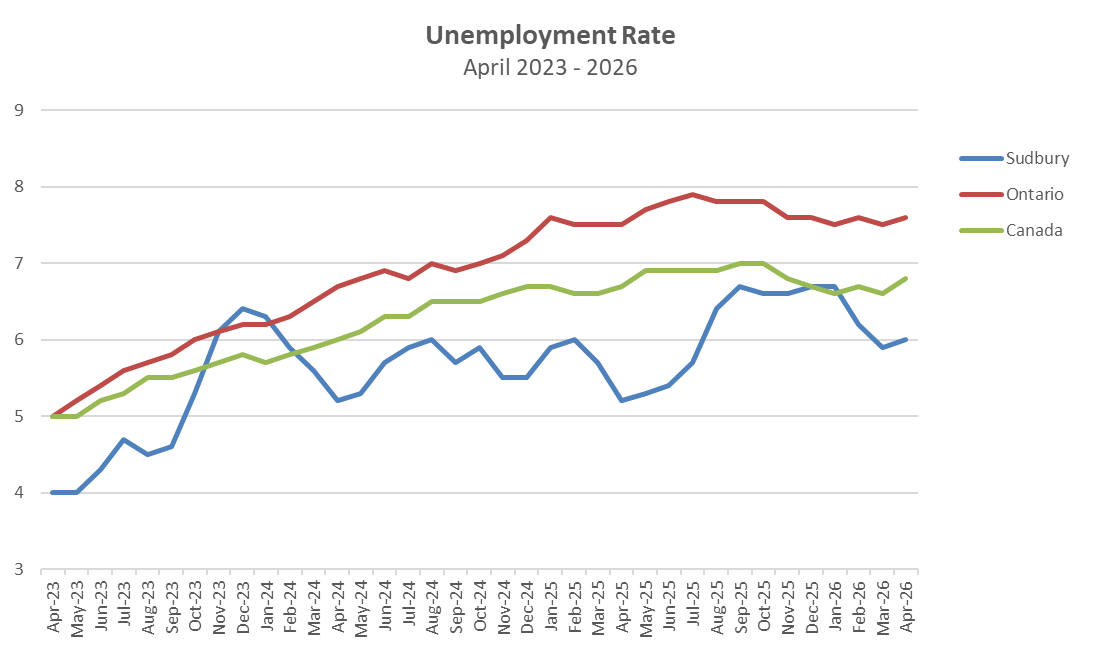
The unemployment rate for Greater Sudbury (Census Metropolitan Area) in March is 5.9%. The unemployment rate in Ontario is 7.5% and Canada is 6.6%.The number of people employed in the city is 99,100, up from 98,800 in February 2026.
The participation rate is 64.2%, a slight decrease from February 2026. The participation rate remains below the pre-COVID peak of 65.1% in May 2019.The Greater Sudbury labour force survey results for March 2026 are in.
Labour Force refers to the total adult population available to the labour market at a specific time. As of March 2026, the labour force of Greater Sudbury (Census Metropolitan Area) is 105,300, remaining the same as February 2026.
The unemployment rate for Greater Sudbury (Census Metropolitan Area) in March is 5.9%. The unemployment rate in Ontario is 7.5% and Canada is 6.6%.The number of people employed in the city is 99,100, up from 98,800 in February 2026.
The participation rate is 64.2%, a slight decrease from February 2026. The participation rate remains below the pre-COVID peak of 65.1% in May 2019. -
Laurentian University Housing Innovation Centre - Featured on CBC
Innovation is happening here at home — and it’s gaining national attention.
CBC’s The National recently explored Canada’s housing crisis and highlighted the groundbreaking work underway at Laurentian University’s Housing Innovation Centre, showcasing its construction robot development and how this technology could help transform homebuilding, and the workforce behind it.
It’s exciting to see the research, talent, and innovation coming out of Greater Sudbury helping position our community as a leader in housing and advanced manufacturing solutions.Watch the full segment here: https://www.cbc.ca/player/play/video/9.7155349
And thank you once again to Steven Beites for presenting this incredible innovation at our winter DLAC mixer last November.Innovation is happening here at home — and it’s gaining national attention.
CBC’s The National recently explored Canada’s housing crisis and highlighted the groundbreaking work underway at Laurentian University’s Housing Innovation Centre, showcasing its construction robot development and how this technology could help transform homebuilding, and the workforce behind it.
It’s exciting to see the research, talent, and innovation coming out of Greater Sudbury helping position our community as a leader in housing and advanced manufacturing solutions.Watch the full segment here: https://www.cbc.ca/player/play/video/9.7155349
And thank you once again to Steven Beites for presenting this incredible innovation at our winter DLAC mixer last November. -
Greater Sudbury Real Estate - February 2026 Outlook
Greater Sudbury Real Estate - Key Highlights from February:
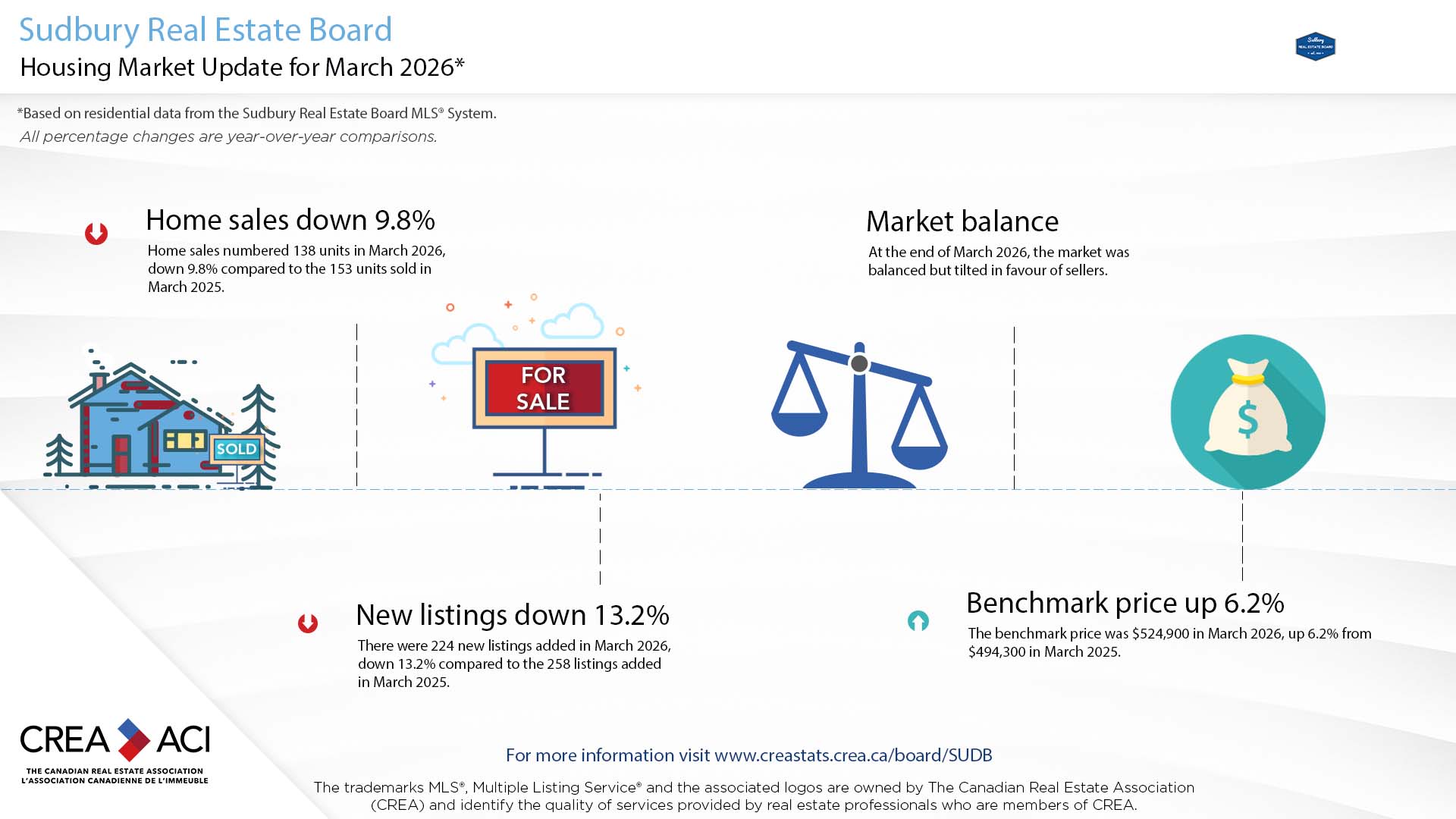
- Home sales were down 8.8% year-over-year, with 124 homes sold compared to 136 in February 2025.
- New listings increased slightly (up 1.0%), suggesting some modest improvement in supply.
- The benchmark home price reached $519,600, representing 8.3% year-over-year growth.
Overall, the market is currently considered balanced following February activity.
Data is provided by the Sudbury Real Estate Board and the Canadian Real Estate Association (CREA).Greater Sudbury Real Estate - Key Highlights from February:
- Home sales were down 8.8% year-over-year, with 124 homes sold compared to 136 in February 2025.
- New listings increased slightly (up 1.0%), suggesting some modest improvement in supply.
- The benchmark home price reached $519,600, representing 8.3% year-over-year growth.
Overall, the market is currently considered balanced following February activity.
Data is provided by the Sudbury Real Estate Board and the Canadian Real Estate Association (CREA). -
Labour Force Survey Results - February 2026
The Greater Sudbury labour force survey results for February 2026 are in.
Labour Force refers to the total adult population available to the labour market at a specific time.
As of February 2026, the labour force of Greater Sudbury (Census Metropolitan Area) is 105,300 a increase of 900 from January 2026.The unemployment rate for Greater Sudbury (Census Metropolitan Area) in February is 6.2%. The unemployment rate in Ontario is 7.6% and Canada is 6.7%.The number of people employed in the city is 98,800, up from 97,400 in January 2026.The participation rate is 64.3%, an increase from January 2026. The participation rate remains below the pre-COVID peak of 65.1% in May 2019.The Greater Sudbury labour force survey results for February 2026 are in.
Labour Force refers to the total adult population available to the labour market at a specific time.
As of February 2026, the labour force of Greater Sudbury (Census Metropolitan Area) is 105,300 a increase of 900 from January 2026.The unemployment rate for Greater Sudbury (Census Metropolitan Area) in February is 6.2%. The unemployment rate in Ontario is 7.6% and Canada is 6.7%.The number of people employed in the city is 98,800, up from 97,400 in January 2026.The participation rate is 64.3%, an increase from January 2026. The participation rate remains below the pre-COVID peak of 65.1% in May 2019. -
City of Greater Sudbury Prepares for 2026 Municipal and School Board Elections
The City of Greater Sudbury has begun preparations for the Municipal and School Board Elections taking place on Monday, October 26, 2026. An update provided at the February 24 City Council meeting outlines key dates and proposed by-laws for matters including internet voting, the use of optical scan tabulators, and restrictions on candidates’ use of municipal resources during the campaign period.
This fall, residents will be encouraged to voice their choice through a hybrid voting model designed for accessibility and convenience. Online voting will be available from Friday, October 16 to Monday, October 26, allowing electors to vote from their own devices at any time and anywhere. Those preferring to vote in person may do so on Election Day or during advance voting on Saturday, October 17 and Saturday, October 24.
Residents are encouraged to ensure their information is up to date in advance of the upcoming elections. As of January 2024, the list of eligible electors for municipal elections is maintained by Elections Ontario, while Municipal Property Assessment Corporation (MPAC) continues to manage school support information. Voter registration can be confirmed at RegisterToVoteON.ca, and school support details can be reviewed at school-support.mpac.ca.
Nominations for Mayor, Councillors, and School Board Trustees open on Friday, May 1, 2026. Prospective candidates are encouraged to monitor the City’s website for forms and updates as they become available from the Ministry of Municipal Affairs and Housing.
The Municipal Elections team will increase public outreach throughout the spring, including voter education tools, registration reminders, and appearances by the Municipal Elections-branded GOVA bus. Information will continue to be updated at: www.greatersudbury.ca/city-hall/municipal-schoolboard-elections/.
The City of Greater Sudbury has begun preparations for the Municipal and School Board Elections taking place on Monday, October 26, 2026. An update provided at the February 24 City Council meeting outlines key dates and proposed by-laws for matters including internet voting, the use of optical scan tabulators, and restrictions on candidates’ use of municipal resources during the campaign period.
This fall, residents will be encouraged to voice their choice through a hybrid voting model designed for accessibility and convenience. Online voting will be available from Friday, October 16 to Monday, October 26, allowing electors to vote from their own devices at any time and anywhere. Those preferring to vote in person may do so on Election Day or during advance voting on Saturday, October 17 and Saturday, October 24.
Residents are encouraged to ensure their information is up to date in advance of the upcoming elections. As of January 2024, the list of eligible electors for municipal elections is maintained by Elections Ontario, while Municipal Property Assessment Corporation (MPAC) continues to manage school support information. Voter registration can be confirmed at RegisterToVoteON.ca, and school support details can be reviewed at school-support.mpac.ca.
Nominations for Mayor, Councillors, and School Board Trustees open on Friday, May 1, 2026. Prospective candidates are encouraged to monitor the City’s website for forms and updates as they become available from the Ministry of Municipal Affairs and Housing.
The Municipal Elections team will increase public outreach throughout the spring, including voter education tools, registration reminders, and appearances by the Municipal Elections-branded GOVA bus. Information will continue to be updated at: www.greatersudbury.ca/city-hall/municipal-schoolboard-elections/.
-
Greater Sudbury Providing an Answer to Canada’s Critical Minerals Future
Global demand for critical minerals is accelerating at a pace few sectors have experienced. The International Energy Agency projects that demand from clean energy technologies could quadruple by 2040. Other international analyses suggest even sharper increases for specific materials such as lithium, where demand could rise 40-times in the coming decades. At the same time, defence systems rely on rare earth elements for radar, satellites, guidance systems and advanced aircraft.
What was once treated by governments as primarily a trade matter now sits at the centre of national security, economic sovereignty, electrification and supply-chain resilience.
Greater Sudbury offers a real-world example of what is needed – and how it can be delivered.
“Mining here isn’t a theoretical possibility,” says Paul Lefebvre, Mayor of Greater Sudbury. “We currently have nine active mines and will have 15 by 2030, five processing facilities, over 350 advanced supply and service companies, research institutes and training facilities, and a workforce that’s been doing this for generations. That existing ecosystem makes it easier – and up to decades faster – to move projects from planning into production. This area is clearly a special economic zone.”
Read the full Globe and Mail article HERE.Global demand for critical minerals is accelerating at a pace few sectors have experienced. The International Energy Agency projects that demand from clean energy technologies could quadruple by 2040. Other international analyses suggest even sharper increases for specific materials such as lithium, where demand could rise 40-times in the coming decades. At the same time, defence systems rely on rare earth elements for radar, satellites, guidance systems and advanced aircraft.
What was once treated by governments as primarily a trade matter now sits at the centre of national security, economic sovereignty, electrification and supply-chain resilience.
Greater Sudbury offers a real-world example of what is needed – and how it can be delivered.
“Mining here isn’t a theoretical possibility,” says Paul Lefebvre, Mayor of Greater Sudbury. “We currently have nine active mines and will have 15 by 2030, five processing facilities, over 350 advanced supply and service companies, research institutes and training facilities, and a workforce that’s been doing this for generations. That existing ecosystem makes it easier – and up to decades faster – to move projects from planning into production. This area is clearly a special economic zone.”
Read the full Globe and Mail article HERE. -
Ontario unseated Saskatchewan as Canada's Top-Rated Jurisdiction for Mining Investment, Ranking 2nd Globally
The Fraser Institute has released the Annual Survey of Mining Companies, and Ontario has ranked 2nd globally as a top-rated jurisdiction for mining investment.
"The Fraser Institute's mining survey is the most comprehensive report on not only mineral potential but also government policies that either encourage or discourage mining investment," said Elmira Aliakbari, director of the Fraser Institute's Centre for Natural Resource Studies and co-author of the study.
This year's report ranks 68 jurisdictions around the world based on their geologic attractiveness (minerals and metals) and government policies that encourage or discourage exploration and investment, including permit times.
On overall investment attractiveness, Saskatchewan (3rd) ranks in the global top ten for the sixth time in seven years, with Ontario leading in 2nd place globally. In terms of policy factors alone, Alberta ranks in the global top three while Ontario ranks 5th, Newfoundland & Labrador ranks 7th, and Saskatchewan ranks 8th globally.
The Fraser Institute has released the Annual Survey of Mining Companies, and Ontario has ranked 2nd globally as a top-rated jurisdiction for mining investment.
"The Fraser Institute's mining survey is the most comprehensive report on not only mineral potential but also government policies that either encourage or discourage mining investment," said Elmira Aliakbari, director of the Fraser Institute's Centre for Natural Resource Studies and co-author of the study.
This year's report ranks 68 jurisdictions around the world based on their geologic attractiveness (minerals and metals) and government policies that encourage or discourage exploration and investment, including permit times.
On overall investment attractiveness, Saskatchewan (3rd) ranks in the global top ten for the sixth time in seven years, with Ontario leading in 2nd place globally. In terms of policy factors alone, Alberta ranks in the global top three while Ontario ranks 5th, Newfoundland & Labrador ranks 7th, and Saskatchewan ranks 8th globally.